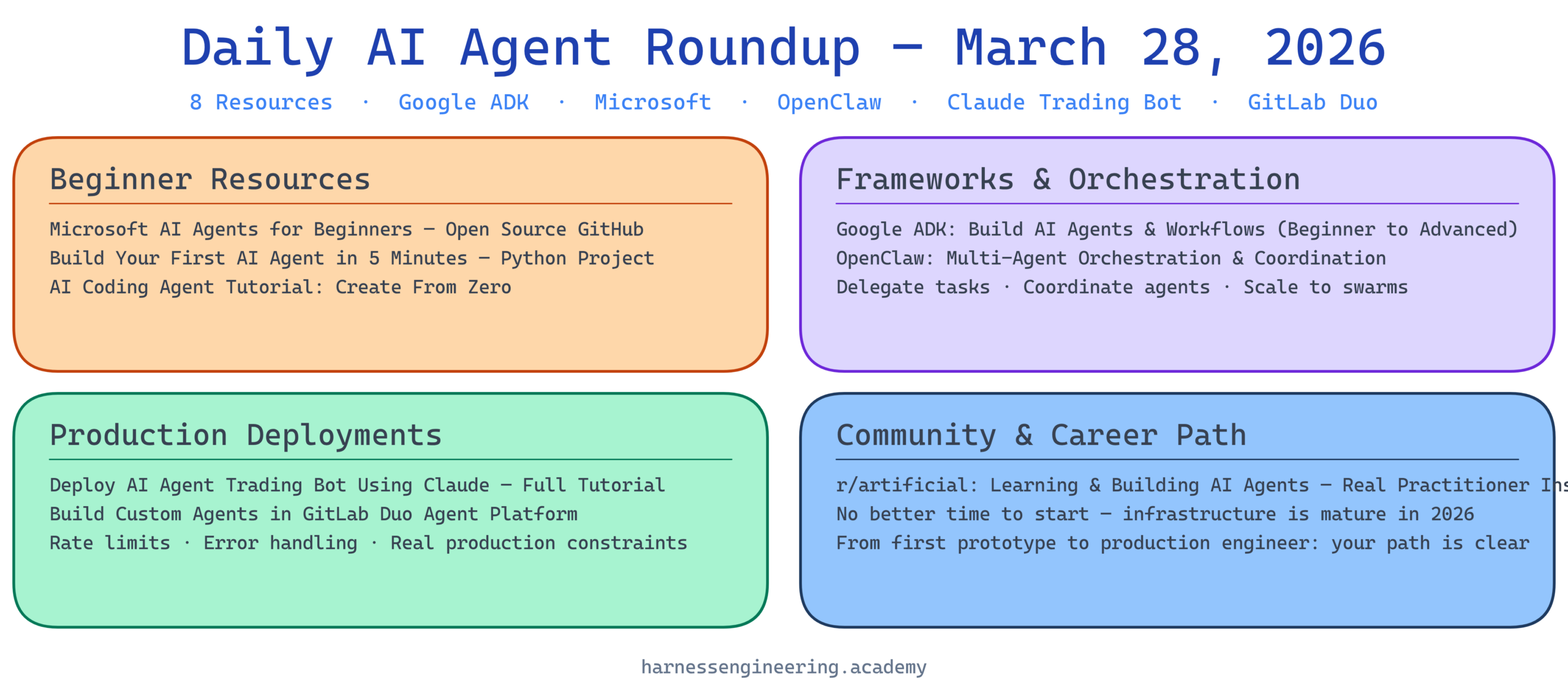
Welcome to today’s roundup! The AI agent field is exploding with new tools, frameworks, and learning resources. Whether you’re just starting your journey or looking to level up your skills, today’s news cycle brings some genuinely useful content that can accelerate your learning. Let’s dive in.
1. Google ADK Tutorial: Build AI Agents & Workflows from Scratch (Beginner to Advanced)
Google’s release of the ADK (Agent Development Kit) provides a comprehensive framework for building AI agents from the ground up, making it essential viewing for developers serious about harness engineering. This tutorial walks you through both foundational concepts and advanced patterns, addressing the full spectrum of learner experience levels. As Google continues to invest heavily in agent infrastructure, their official educational content becomes a critical resource for staying aligned with industry standards.
Why this matters for your learning journey: Official documentation and tutorials from major platforms like Google are your best bet for learning frameworks that won’t become obsolete in six months. The ADK represents the thinking of one of the largest AI infrastructure teams on the planet, so understanding their approach to agent design patterns will make you a stronger engineer regardless of which framework you ultimately use.
2. microsoft/ai-agents-for-beginners
Microsoft’s beginner-friendly lessons offer a timely, structured resource for those entering the AI agent field at a moment when demand for practical education is skyrocketing. This GitHub repository provides hands-on lessons and examples that build progressively, removing the intimidation factor many beginners face when encountering agent concepts for the first time. The open-source approach means you can learn directly from code, ask questions via issues, and contribute back to the community.
Why this matters for your learning journey: Learning from real code repositories is invaluable because it shows you not just what to do, but why decisions are made the way they are. Microsoft’s material is battle-tested in their own production environments, which means you’re learning approaches that scale. This is perfect for building your foundational mental model before moving to advanced concepts.
3. Multi Agent Orchestration with OpenClaw
As multi-agent systems become more prevalent in real-world deployments, understanding orchestration techniques is vital for developers looking to build sophisticated autonomous AI agents. This tutorial dives into how multiple agents coordinate, communicate, and hand off tasks to one another—a critical capability once you move beyond single-agent chatbots. OpenClaw provides a practical framework for thinking about agent coordination patterns.
Why this matters for your learning journey: Most of your early agent projects will likely be single-agent systems. But as you advance in your career, you’ll encounter problems that genuinely require multiple specialized agents working together. Getting ahead of the curve on orchestration patterns positions you as someone who understands real-world complexity, not just toy examples.
4. Build Your First AI Agent in 5 Minutes | Agentic AI Course | Python project
Quick-start guides are powerful confidence boosters when you’re new to a field, and this rapid-fire tutorial gets you to a working agent faster than you might think. Rather than spending weeks on theory, you’ll have a functioning prototype in under five minutes, which is psychologically important—seeing something work immediately makes abstract concepts concrete. The Python-based approach also matches the language most AI engineers use day-to-day.
Why this matters for your learning journey: Sometimes the best way to learn is to build something immediately, then learn the why afterward. This tutorial is perfect for your first day of agent engineering. Once you’ve built and run that initial prototype, all the theoretical content you encounter next will make infinitely more sense because you’ll have context.
5. Deploy Your Own AI Agent Trading Bot Using Claude Full Tutorial
With growing interest in autonomous trading, this comprehensive guide demonstrates how to build and deploy a real-world agent application using Claude and actual financial data. Trading bots represent one of the most tangible use cases for agentic AI—they make decisions with actual consequences, handle real-time information streams, and must be robust enough for production use. This isn’t theoretical; it’s applied engineering with measurable outcomes.
Why this matters for your learning journey: If you want to build AI agents professionally, studying real use cases like trading bots teaches you constraints you won’t find in toy examples. You’ll learn about rate limiting, error handling, state management across sessions, and the importance of fail-safes. These are the skills that separate junior engineers from people who can ship agents at scale.
6. Learning and Building AI Agents
This Reddit discussion thread captures authentic conversations between practitioners at all skill levels, offering a grassroots perspective on what people are actually struggling with as they learn agent engineering. Unlike polished tutorials, Reddit conversations surface real pain points: “How do I choose between frameworks?” “What should my first project be?” “How do I handle agent hallucinations in production?” These are questions you’ll ask yourself, and seeing how the community thinks through them is invaluable.
Why this matters for your learning journey: Community forums are where theory meets reality. You’ll discover that your struggles aren’t unique, you’ll learn from others’ mistakes before making them yourself, and you’ll start building your professional network before you even have your first agent job. Lurk in these conversations, ask questions respectfully, and contribute your own insights as you progress.
7. How to Create an AI Agent From Zero — AI Coding Agent Tutorial
This tutorial emphasizes building from first principles, starting with the most basic agent concepts before layering on complexity. The “from zero” framing is important—it means the instructor doesn’t assume you already understand agent architecture, and each step builds logically on the previous one. For beginners, this structured progression prevents the cognitive overload that comes with being thrown into advanced frameworks without foundational knowledge.
Why this matters for your learning journey: Fundamentals matter more than you might think. It’s tempting to jump straight to using Claude, LangChain, or AutoGPT, but understanding how these frameworks work under the hood makes you adaptable. When a new framework emerges next year, you won’t feel lost because you’ll understand the underlying principles that all agents share.
8. How to Build Custom Agents in GitLab Duo Agent Platform
GitLab’s approach to agents demonstrates how AI is integrating into the entire DevOps lifecycle, from code planning through deployment and monitoring. Building custom agents within an established platform like GitLab teaches you how agents fit into existing workflows and enterprise constraints. This is particularly valuable if you’re considering agent engineering as a career path—understanding enterprise integration patterns makes you immediately valuable to companies building production systems.
Why this matters for your learning journey: Startups and indie projects might build agents in isolation, but enterprises need agents that integrate seamlessly with their existing toolchains. Learning platforms like GitLab Duo prepares you to think about agent engineering from a systems perspective. This skill—integrating agents into larger ecosystems—is genuinely rare and in high demand.
Your Takeaway: Build Your Agent Engineering Learning Path
Today’s news tells a clear story: the agent engineering field has matured from “experimental” to “ready for production.” Every major platform—Google, Microsoft, GitLab, Anthropic—is releasing agent frameworks and educational content. What does this mean for you?
You have no better time to start than right now. The infrastructure is mature, the tutorials are abundant, and the job market is hungry for engineers who understand agents. Start with the quick 5-minute build, progress through Microsoft’s structured beginner lessons, understand orchestration patterns, then move into real-world applications like trading bots or DevSecOps integration.
Your learning path doesn’t have to be linear. Mix official documentation with community forums. Build toy projects, then study production-grade code. Most importantly, build things. Every tutorial here emphasizes hands-on coding, and that’s exactly the right approach. You’ll learn more from building a broken agent and fixing it than from watching ten hours of perfect tutorials.
The field is accelerating. The engineers who will be in highest demand over the next 12 months are those who start learning today. Use these resources, join the communities, build projects, and share what you learn. That’s how you become an AI agent engineer.
What are you building first? Share your learning plan in the comments or in our Harness Engineering community. We’d love to follow your journey!